
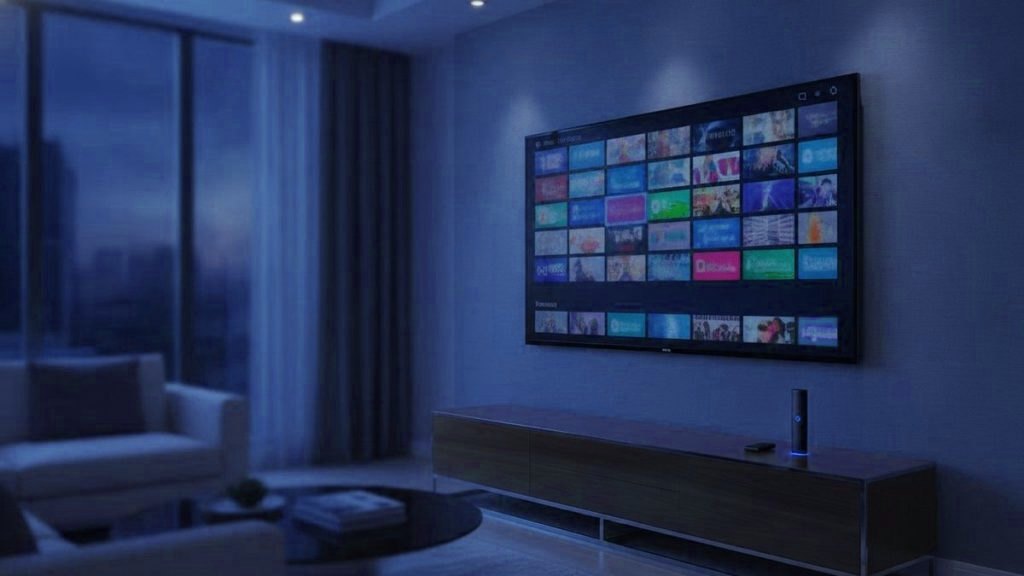
The streaming bill your household pays this month probably has four or five line items, and the television it buys you probably does not include a single live sports channel. That is the problem IPTV solves, and understanding what IPTV is starts by understanding what streaming decided not to be.
Streaming platforms are catalogues. They are extraordinarily good at what they do — licensing finished programmes, making them available on demand, at quality levels that were impossible five years ago. What they are not, by design, is a replacement for a cable or satellite service. The live channel grid — news, sport, whatever is on tonight rather than whatever you chose — was never their business model. They sold you on-demand and they built on-demand infrastructure. Live television, with its unpredictable timing and its requirement to serve the same stream to millions of people simultaneously, is a different and more expensive problem.
IPTV solves it a different way. Instead of a broadcast signal sent via cable or aerial, or a content catalogue served from a CDN, it delivers live channels as a data stream — the same way a video call or a radio stream works, one connection to one viewer, with the channel you chose and only that channel.
What the technology actually does
When you open an IPTV player and select a channel, your player connects to a server and requests that channel’s stream. The server begins sending compressed video data, cut into small numbered segments a few seconds long each. Your player collects several of those before it starts playing — that collection is the buffer — and plays from the buffer while continuing to collect. If the buffer runs dry, playback pauses. If segments arrive faster than they play, it empties more slowly and you get the headroom to survive a brief network interruption.
This is why two households on the same broadband speed can have completely different results from the same service. The connection is one factor; the server on the other end, and how many other viewers it is serving at the same moment, is equally important. A provider who charges very little buys server capacity to match, and the first major sporting event makes it visible. Your equipment and connection have not changed; the queue in front of you has.
The practical implication: test during a live event, not during a quiet weekday morning. Every provider performs well with half-empty servers. Only the ones who sized their infrastructure for peak load hold up when it matters.
What streaming replaced, and what it left out
When cable subscriptions started declining, it was described as consumers cutting the cord. What actually happened was more selective. People dropped the parts of the cable bundle they could replicate on streaming platforms — the box sets, the film libraries, the network television episodes. They kept paying for the parts they could not replicate: live sport, news, rolling coverage. Many of them kept paying for cable or satellite solely for those things, while also subscribing to multiple streaming services for the catalogue content.
The result, around a decade later, is the same bill but more complex. A household paying for one streaming platform in 2016 is likely paying for three or four now, plus a sports add-on, plus kept its cable or satellite subscription, plus added a few single-channel subscriptions for specific content. The total is frequently higher than the original cable bill it was supposed to replace, and the live content is still fragmented across providers who each hold rights to a different league or competition.
IPTV addresses the live content specifically. It does not replace a film catalogue — there is no point comparing a 120,000-title VOD library to a curated streaming service with original programming. What it does replace is the live channel grid: the news channels, the sports channels from multiple countries, the entertainment channels that run scheduled programming rather than an on-demand library.
How IPTV and streaming compare
| Streaming platforms | IPTV | |
|---|---|---|
| What arrives | On-demand catalogue: finished programmes, films, original content | Live channels on a schedule, with a VOD library alongside |
| Live sport | Limited and fragmented: a single league on one platform, a different league on another | The main reason most subscribers are here — multiple sports packages from multiple countries |
| Live news | Generally absent from major platforms | News channels from the US, UK, Europe and beyond, running continuously |
| Programme guide | Not applicable — you choose what to watch | A full EPG, the same grid format as cable |
| Original programming | The central investment of major platforms | Not applicable — no original production |
| Price | $8–$22 per platform, per month, and most households subscribe to more than one | $15 per month covers the live channel grid across all the platforms’ gaps |
They solve different problems. Streaming replaced the video shop. IPTV replaces the channel grid. The households who get the most value from combining them are those who were already paying for both separately — the streaming catalogue plus the sports cable package — and can now consolidate the channel-grid portion into one subscription.
What you need to get started
A broadband connection. Around 25 Mbps is comfortable for 4K; 10 Mbps is enough for HD. Consistency matters more than peak speed. The buffer only empties when the connection drops below a sustained minimum, and that happens on a congested Wi-Fi network more often than on a slow but steady one. An Ethernet connection to the television, even a cheap adapter on a device that does not have a port built in, is the single most reliable improvement available.
A device to run a player on. Any device that currently runs Netflix will run an IPTV player. A Fire TV Stick, an Android box, a Samsung or LG smart television from the last eight years, an Apple TV, an iPhone or iPad, a Windows or Mac computer, a MAG or Formuler set-top box — all of them have player apps available. The device does not need to be new. The player does not cost anything.
A player app. The player holds no channels of its own. It is an empty shell waiting for login credentials from a subscription. IPTV Smarters Pro and TiViMate are the most widely used and both handle the Xtream Codes format that most providers issue. The single most common point of confusion for first-time users is expecting the player to work before the subscription is added. It will not. The player is the television set; the subscription is the signal.
A subscription. This is where quality is set. The player, the device, and the broadband can all be excellent, and a cheap provider with overloaded servers will still produce buffering and freezing. The subscription cost is not the whole story of what you are paying for — it is the least informative number in the comparison. What matters is server capacity relative to the subscriber base, and the only way to test that directly is a trial at peak hours.
Two credentials, one login
Most IPTV subscriptions issue what is called an Xtream Codes login: three values — a server address, a username, and a password. Enter those three into any compatible player and it populates with every channel the subscription covers. This is the standard format and the reason the same login works across different players and different devices. You are not locked to a particular app or piece of hardware.
The alternative format is an M3U link, a single long URL that carries the same credentials as parameters. Players like VLC and Kodi use M3U files directly. Either format gives you the same channels — the difference is in how you enter the credentials, not what you get.
The trial is the only reliable test
No written specification tells you what a service actually performs like under load. Channel counts, uptime figures and resolution claims are easy to publish and impossible to verify from outside. The one test that actually answers the question is a trial — specifically a trial used at peak hours, during a live event, on the device you will use day to day, on the network that device normally uses.
A morning trial on a quiet network with no events running tells you almost nothing. It confirms the server exists and the player works. It does not tell you whether the Super Bowl stream will hold at kick-off or whether the Premier League Saturday afternoon matches will buffer on every goal.
The questions worth asking before subscribing: Is a trial available without a card? How many days does the refund cover? Are prices published openly and consistently, or do they vary depending on who is asking? Does anyone answer before you pay? These are not filtering tests for bad providers specifically. They are minimum conditions for any service you are trusting with a monthly payment.
One IPTV subscription covering the live channel grid, used alongside one or two streaming platforms for catalogue content, is usually a lower total bill than the streaming stack plus the sports cable add-on that it replaces. The live television was always the expensive part. This is what it costs when it is priced as one subscription rather than as an add-on to each platform individually.
Frequently asked questions
What does IPTV actually stand for?
Internet Protocol Television. The term describes how the signal travels: over your existing broadband connection rather than via a cable, dish or aerial. The content itself — live channels, sport, news — is the same. The delivery method is different and cheaper.
Will IPTV replace my streaming services?
Partially, if those services are where you currently pay for live channels and sport. IPTV covers the live channel grid that streaming platforms were never designed for: scheduled television, sport as it airs, rolling news. The on-demand catalogue that Netflix or a similar service provides is a separate product with no equivalent in IPTV. Most households keep one streaming platform alongside IPTV and drop the rest.
How much data does IPTV use per hour?
Around 2-4 GB for an HD stream and 7-10 GB for a 4K stream, depending on the bitrate each channel uses. On an uncapped home broadband connection this is rarely a concern. On a mobile data allowance it adds up quickly, which is why most people use IPTV on a home Wi-Fi network rather than a cellular connection.
What is the difference between Xtream Codes and an M3U link?
Two formats for the same access. An Xtream Codes login is three separate values: server address, username, password. An M3U link is one URL that encodes those same credentials as parameters. Either format gives you the same channels. Which one you use depends on your player app. Xtream Codes is standard for most dedicated IPTV apps; M3U suits VLC and Kodi.
What internet speed do I need for IPTV?
A steady 10 Mbps handles a single HD stream; 25 Mbps handles a single 4K stream. Consistency matters more than peak speed. A wired Ethernet connection to the television device removes most buffering caused by a congested Wi-Fi network and is the single most effective quality improvement available without changing the subscription.
Can I try IPTV before I pay?
Yes. A reputable provider will offer 24 to 48 hours of full access with no card required. Use the trial during a live event on the device you plan to use every day. That test tells you whether the service holds up under peak load, which is the only data point that matters when deciding whether to pay.
Work out what it would replace
Tell us what you currently pay for and we will say plainly which of it this covers and which of it it does not. Then take a 24-hour trial and check for yourself before cancelling a single thing.
Related articles
Best IPTV Box in 2026: Formuler Z11 vs Nvidia Shield vs Fire TV Stick 4K Max
The best IPTV box is almost certainly one you already own. If you need hardware, a Fire TV Stick 4K Max covers…
September 4, 2026Best IPTV Apps in 2026: TiViMate vs Smarters vs Smart IPTV vs IBO Player
IPTV Smarters Pro, TiViMate, Smart IPTV, IBO Player — each one suits a different device and use case. The player is free;…
September 2, 2026How Much Does IPTV Cost in 2026? Real Prices From 5 Providers
An IPTV subscription costs $12–$25 per month. The number that matters is not the IPTV price in isolation but what it sits…