
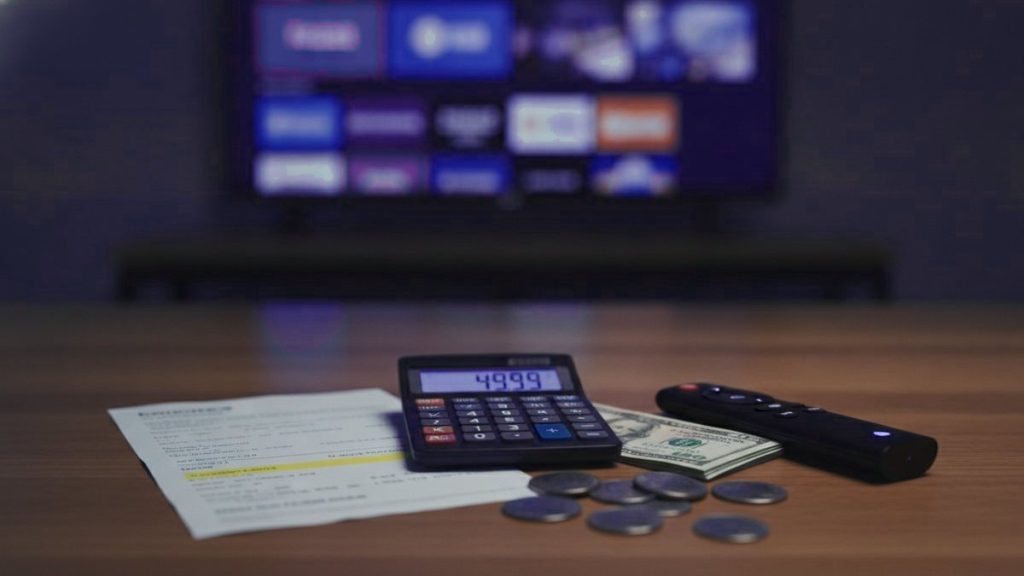
An IPTV subscription from a reliable provider costs between $12 and $25 per month, depending on the number of simultaneous connections and the length of the payment period. That is the direct answer to the question. What makes the number meaningful is what it sits next to — specifically, what the household was already paying for the same content it replaces.
Most households evaluating IPTV are not starting from zero. They are already paying for one or more streaming platforms, possibly a sports add-on, possibly a cable or satellite subscription carried over from before streaming became mainstream. The IPTV price is only meaningful as a replacement cost, and understanding what it replaces — and what it does not — is the calculation that decides whether it is worth it.
What a household currently pays
In 2026, a fairly typical US household paying for television spends money across several categories:
| Service | Approximate monthly cost | What it covers |
|---|---|---|
| One major streaming platform (Standard/no ads) | $18–$22 | On-demand catalogue, original programming |
| A second streaming platform | $10–$18 | Different catalogue, different originals |
| Sports add-on or sports-specific platform | $11–$49 | One or two sports packages |
| Cable or satellite (kept for live channels and local news) | $60–$110 | Live channel grid, local stations, sports |
A household paying for two streaming services and keeping a basic cable package for live content is spending over $100 a month on average. A household that added a sports streaming service on top is closer to $130–$160. These are not unusual cases — they are the predictable outcome of a decade in which content was spread across more platforms than any single platform could justify buying.
What IPTV costs
A mid-range IPTV subscription with a single connection costs around $15 per month. Paid quarterly, the monthly equivalent drops below $12. Paid annually, it can reach $5–$7 per month. The pricing model is straightforward: longer commitment, lower effective rate, no automatic renewal without your explicit action.
The variable that moves the price upward is the number of simultaneous connections — how many screens in the household can watch different things at the same time. A single-connection plan is fine for a household that primarily watches one screen at a time. A family household where the television, a bedroom, and a laptop might all be in use simultaneously needs two or three connections. Each additional connection typically adds $3–$6 per month to the base price.
Providers who price IPTV at $3 per month are generally not charging the equivalent of what server capacity and content access actually cost. That is not a universal rule — there are legitimate budget services — but it is a reliable starting heuristic. The price of a service and the quality of its infrastructure during a live event are correlated, not perfectly but consistently.
The replacement calculation
The households that see the clearest financial benefit from an IPTV subscription are those currently paying for cable or satellite primarily for its live channel grid — specifically for sport and news — while also paying for streaming platforms for the on-demand content the cable package does not provide well.
In that scenario, IPTV replaces the cable subscription. It covers the live channel grid, including sports and news from multiple countries, at a fraction of the cable cost. The streaming platforms cover the catalogue and original programming, which IPTV is not designed to replace. The net position, for a household that was paying $90 per month for cable plus $36 for two streaming platforms, is a $15 IPTV subscription plus $36 for two streaming platforms — $51 instead of $126. The monthly saving is about $75, the annual saving over $900.
The households that see a smaller benefit are those whose existing spend was already low. A household paying only for one streaming platform and nothing for live television is comparing $15 against $0 for the live channel addition. That is a new cost, not a replacement, and the calculation is simply whether the live content is worth $15 per month.
What the price includes
The base subscription price at most reputable providers includes the full channel count, the VOD library, the EPG programme guide, and access across every device that runs the player app. There are no channel tiers, no sports add-ons, and no HD or 4K upgrades. You get the complete package at the plan price.
What the plan price does not include: hardware (player, television, Ethernet adapter if you need one), the broadband connection, or any streaming platform you continue to subscribe to. The IPTV subscription replaces the live channel part of the bill. It does not replace the internet service or the devices on which it runs.
Trial costs nothing
Reputable providers offer a trial period before requiring payment. For most services, this is 24 to 48 hours of full access on a single connection. No card is required, which means the trial period is genuinely free rather than a subscription that begins automatically unless cancelled.
The trial is not just a sales mechanism. It is the correct way to evaluate an IPTV service, because the price tells you almost nothing about performance. The only test that matters is the one you run on your own equipment, on your own network, at peak hours, during a live event. A service that performs well during that test at $15 per month is worth more than a service that costs $8 per month and freezes during the match.
What you do not need to spend money on
The player app is free. IPTV Smarters Pro, TiViMate (for Android), Smart IPTV, and the browser-based player are all available without a subscription cost. The paid versions of some apps add minor convenience features — TiViMate’s premium tier, for example, includes additional playlist slots and some interface customisation — but none of them are required to get a functional service working on any device.
The device itself may already be in the household. Any device currently running Netflix — a Fire TV Stick, an Android box, a Samsung or LG smart television, an Apple TV, an iPhone or iPad, a Windows PC or Mac, a Roku — will run an IPTV player without modification. If the existing hardware works, the only cost is the subscription.
Comparing the math to a streaming stack
The streaming industry’s shift toward advertising-supported tiers has made the cost of ad-free access increase substantially at the platforms most people actually use. A household subscribing to three platforms at their ad-free tier in 2026 is paying roughly the same amount as a cable subscription cost five years ago — and still missing live sport and local news.
One IPTV subscription for the live channel grid, combined with one or two streaming platforms for catalogue content, is frequently a lower total than three streaming platforms plus the live content that those platforms do not provide. The live channel gap is the expensive part of the television bill. That is what IPTV replaces, and $15 per month is what it costs when priced as a single subscription rather than fractured across several.
The calculation for any specific household starts with the current bill: write out every television subscription line item and what it covers. Then identify what IPTV would replace — the cable or satellite package, the sports add-on, the platform kept mainly for live content. Subtract that amount and add $15. The result is the new total. For most households currently paying over $80 per month on television, the new total is lower.
Payment terms and what they mean
IPTV subscriptions are typically sold in monthly, quarterly, six-monthly, and annual tiers. The price difference between monthly and annual is significant — a service charging $15 per month may charge $45 for a quarter (equivalent to $15 per month with no discount) but $69 for a year (equivalent to $5.75 per month). That is a genuine and material difference for a service used consistently.
The risk of longer payment terms is that if the service declines in quality or shuts down, you lose more. The standard advice is to use monthly billing for the first one or two months while confirming performance during live events, then switch to the annual rate once satisfaction is established. This approach costs about $10–$20 more than going straight to annual, and it is usually worth it.
One thing reputable providers do not do: automatic renewal without explicit consent. A subscription should expire at the end of the paid period unless you choose to renew. Any provider whose terms suggest automatic billing unless cancelled is not operating with the level of transparency that justifies the longer-term commitment.
Add-ons you should not need to pay for
On a quality IPTV subscription, the following are included in the base price without any additional charge:
- 4K and HD streams. There are no resolution tiers on a properly structured subscription. Every channel is available in the best quality the provider carries.
- The EPG (programme guide). The grid that shows you what is on and what is coming up is part of the service.
- All channel categories. Sports, news, entertainment, kids, international — not separated into tiers that need to be unlocked.
- Access on all compatible devices. The number of simultaneous connections is the plan variable, not the device types permitted.
- VOD library access. The on-demand films and series library comes with the subscription.
If a provider is charging separately for HD quality, for the EPG, for specific channel packages, or for device compatibility beyond a single type, those are signs of a pricing model designed to extract more money per subscriber rather than to provide a better service. Compare the all-in cost rather than the headline price.
Connections versus streams
The terminology around simultaneous connections (also called screens or streams) is worth clarifying, because it is often confused with accounts.
A single IPTV subscription with two simultaneous connections means two screens in the same household can watch different channels at the same time. It does not mean two different households can use the same subscription. Most providers prohibit sharing outside the household, and the technical enforcement is not always strict, but the terms exist for a reason: simultaneous connections are how infrastructure capacity is sold, and sharing a two-connection subscription across five households exceeds what was provisioned.
For most households, a single connection is sufficient. The television and a phone or tablet rarely need to stream different channels simultaneously. Two connections cover the case where two people in the house watch different things at the same time. Three or four connections are genuinely needed only in larger households with independent viewing in multiple rooms simultaneously.
The price difference per connection is typically $3–$6 per month. Paying for connections you will not use is waste; underpaying for connections and running into the limit when two people want to watch different things simultaneously is equally frustrating. If uncertain, start with one and upgrade if the limit is reached in practice.
Frequently asked questions
How much does IPTV cost per month?
From about $12 to $25 per month for a reputable service, depending on the number of simultaneous connections and the billing period. A single-connection plan paid annually typically works out to $5-7 per month. The price per month is not the most useful number to compare — the useful number is the household's total television bill before and after.
Why are some IPTV services so cheap?
Because they are not paying for what they carry. Rights to major sport and entertainment are expensive. A service charging $3 per month is unlikely to have licensed NFL games, Premier League matches, or premium film channels. Infrastructure is also expensive: a service that is implausibly cheap either has no rights, no server capacity, or both — and both problems become visible during live events.
Is it worth paying for an annual IPTV plan?
Once you have confirmed the service performs during live events on your own network, yes. The annual rate is typically 50-60% less than paying monthly. The standard approach is to pay monthly for one or two billing cycles while verifying performance, then switch to annual once satisfied. The extra monthly cost during that period is cheap insurance.
What does an IPTV subscription include?
On a properly structured plan: the full channel count in every available quality (4K, FHD, HD), the EPG programme guide, the VOD library, and access on every device that runs a compatible player. There are no channel tiers to unlock and no quality upgrades to pay for separately. The plan variable is how many screens can watch simultaneously.
How does IPTV compare in cost to cable TV?
A basic cable package in the US costs $60-$110 per month. An IPTV subscription covering the live channel content costs $15 per month. For a household that keeps one or two streaming platforms alongside IPTV, the total is typically $40-$55 per month — roughly half to a third of what cable plus streaming services cost combined.
Can I share an IPTV subscription with family?
Within the same household, yes — that is what simultaneous connections are for. A two-connection plan allows two screens in the house to watch different channels at the same time. Sharing across different households usually violates the provider's terms and is not what the pricing is set up for.
Work out what it would replace
Tell us what you currently pay for and we will say plainly which of it this covers and which of it it does not. Then take a 24-hour trial and check for yourself before cancelling a single thing.
Related articles
Best IPTV Box in 2026: Formuler Z11 vs Nvidia Shield vs Fire TV Stick 4K Max
The best IPTV box is almost certainly one you already own. If you need hardware, a Fire TV Stick 4K Max covers…
September 4, 2026Best IPTV Apps in 2026: TiViMate vs Smarters vs Smart IPTV vs IBO Player
IPTV Smarters Pro, TiViMate, Smart IPTV, IBO Player — each one suits a different device and use case. The player is free;…
August 31, 2026Is IPTV Legal in the US? A Plain-English Guide for 2026
IPTV as a technology is entirely legal. The question that matters is whether a specific service holds the rights to what it…